Redesign of RE/MAX Argentina's lead management process. From an email-based workflow across 160+ offices to a centralized system with traceability.
ClientRemax
Year2022
ScopeProduct Design / UX Research
Context
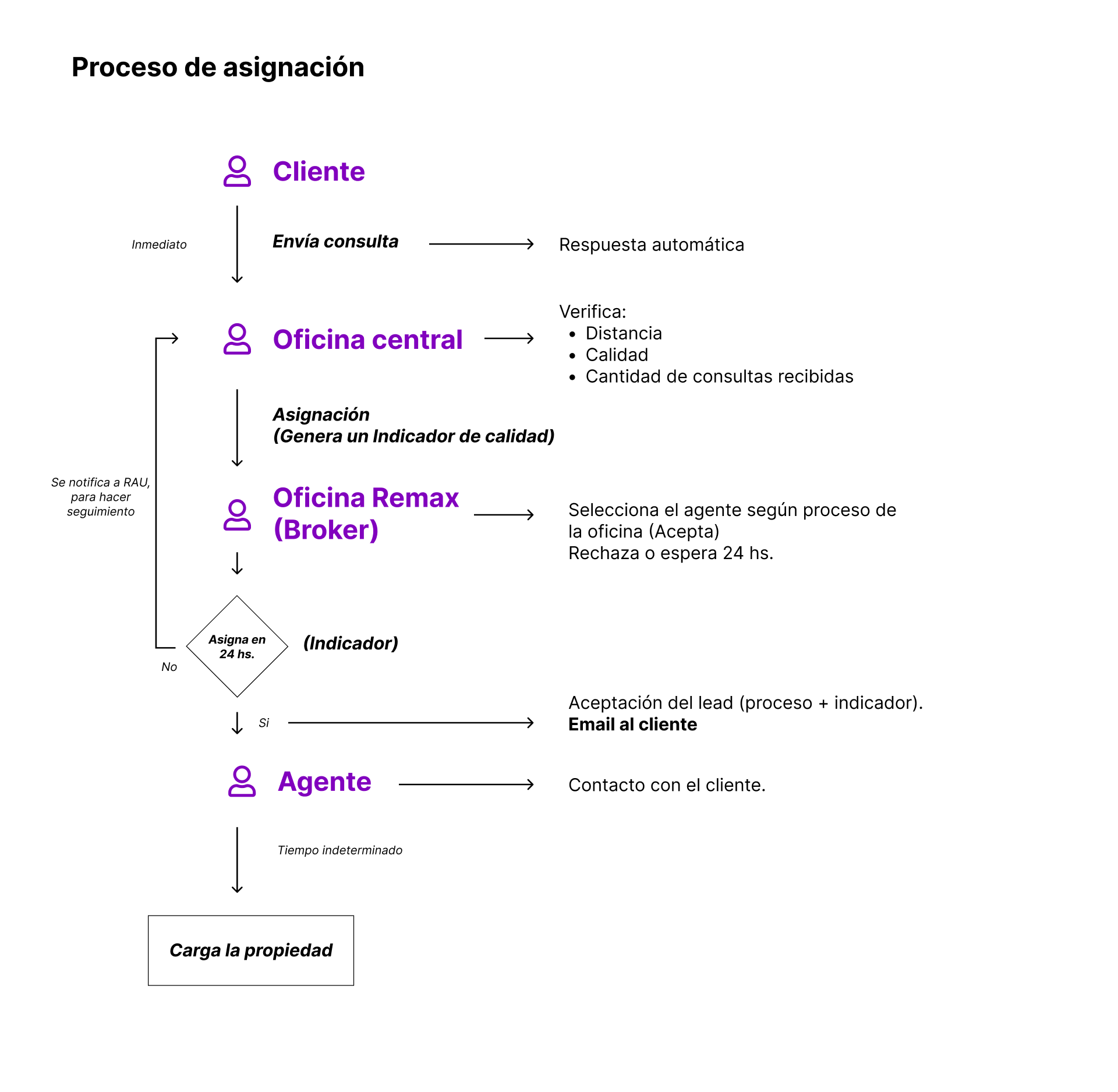
RE/MAX Argentina received property inquiries through a web form that led to a manual workflow between three areas: the central team, RE/MAX offices, and agents. Each lead circulated by email, without a system to provide visibility or continuity across the process.
The challenge
The challenge was to propose a flow within the existing Red RE/MAX system that could be adopted in stages, without forcing a cultural change overnight.
To do this, it was necessary to understand how the three areas involved worked, identify the real points of friction, and design a solution that supported the existing process while also making it more organized and scalable.
My role
Within the Kambrica team, my role combined research and product design: I conducted exploratory interviews with the three user profiles, led usability testing sessions on the functional prototype, and translated the findings into the system design decisions.
Goals
Business goals
Centralize lead management within a single platform (Red RE/MAX).
Provide traceability across the full cycle: received → assigned → accepted → contacted → listed.
Lay the groundwork for future automated assignment and for metrics to evaluate performance by office and by agent.
Experience goals
Reduce manual coordination time between the central team and RE/MAX offices.
Give agents clarity on the expected actions at each step.
Build a simple, scalable system that can accommodate new features without overwhelming agents.
Research and insights
The process began with in-depth interviews with the three areas involved: agents, office managers, and the central team. The goal was to map the existing flow end to end and identify the real points of friction.
Methodology
I conducted exploratory interviews with the teams from the three areas involved.
I mapped the full flow alongside the team, from inquiry to assignment.
I analyzed the parallel tools agents used outside the system.
Main findings
Agents only used Red RE/MAX once a property had already been listed. The entire prior process lived in email and personal tools.
RE/MAX office managers showed explicit resistance to automatic assignment: not all agents take all properties, and agent duty rotations had too many exceptions to be easily automated.
Two of the five agents interviewed openly said they would keep using their personal spreadsheets "just in case," even with the new system implemented.
Roadmap
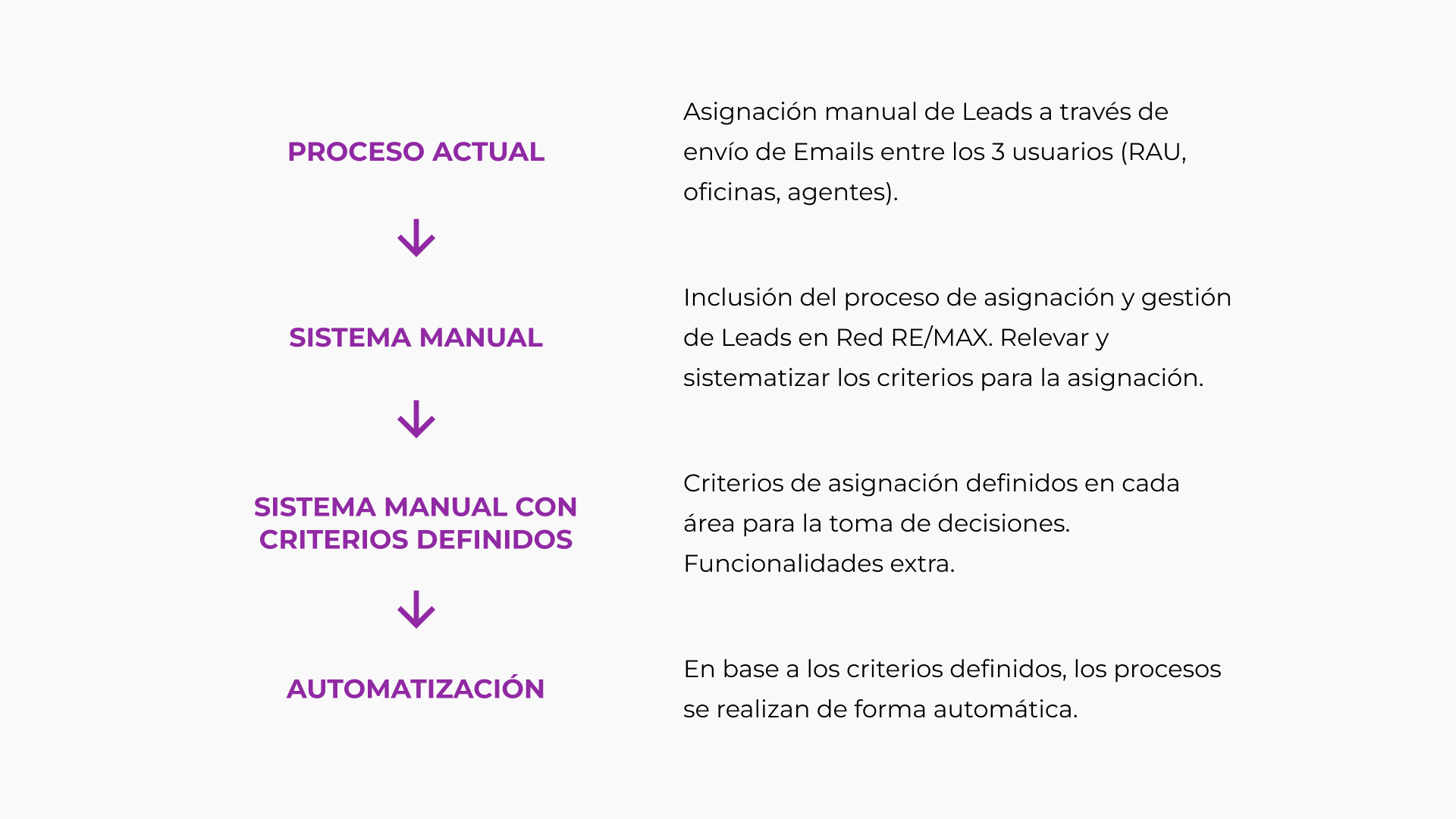
Based on the findings, it became clear that the solution could not be a fully automated system. Office managers would not accept it, agents would not trust it, and the implementation of the process would be at risk.
The decision was to design the system in four progressive stages, each one laying the groundwork for the next. The scope of this stage was manual but traceable assignment.
Solution
I worked on the design of a workflow integrated into the existing platform to centralize lead management. The workflow was organized around three touchpoints:
The central team assigning leads to RE/MAX offices.
Office managers assigning leads to their agents.
Agents accepting and managing the lead.
Key components
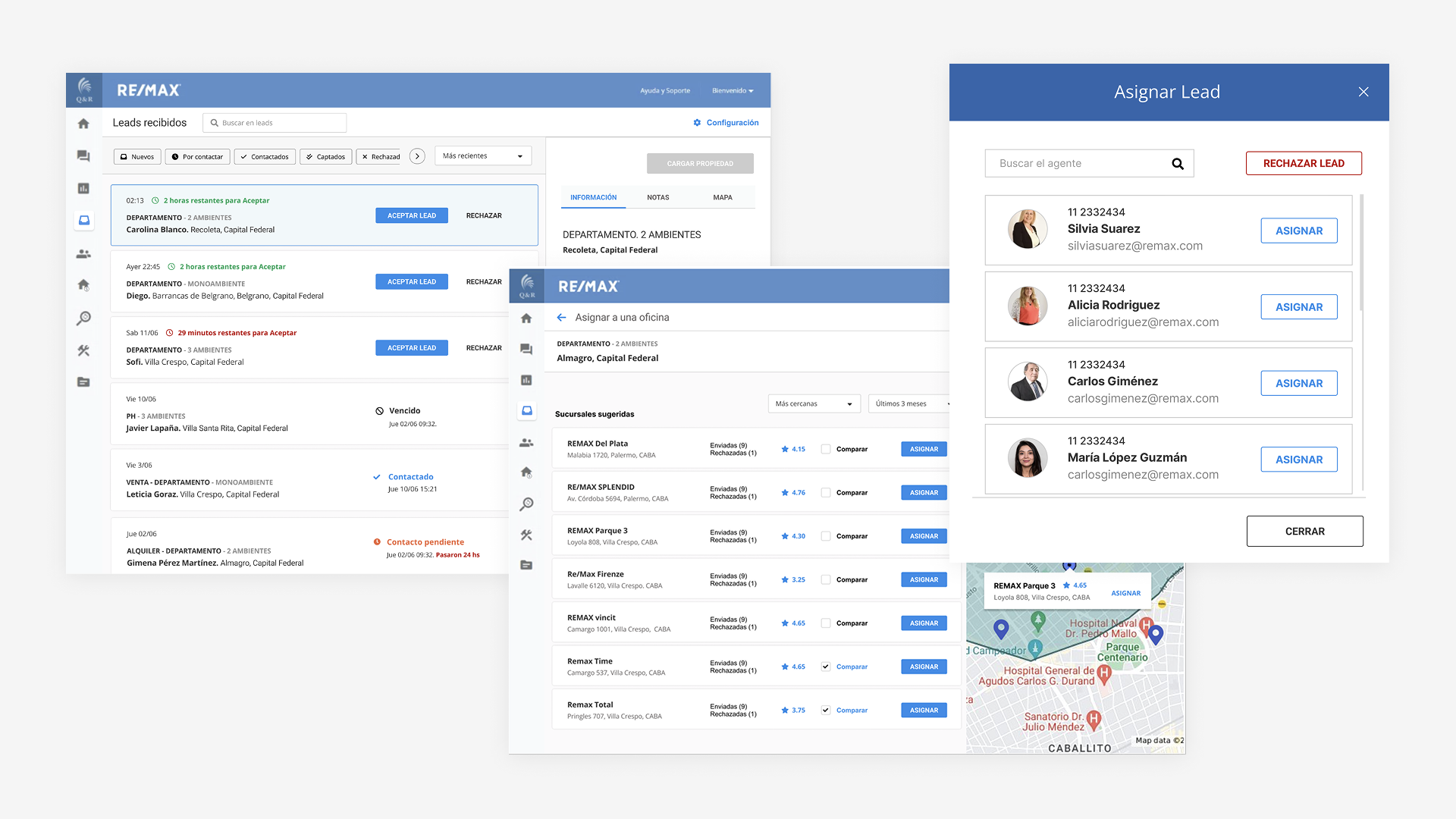
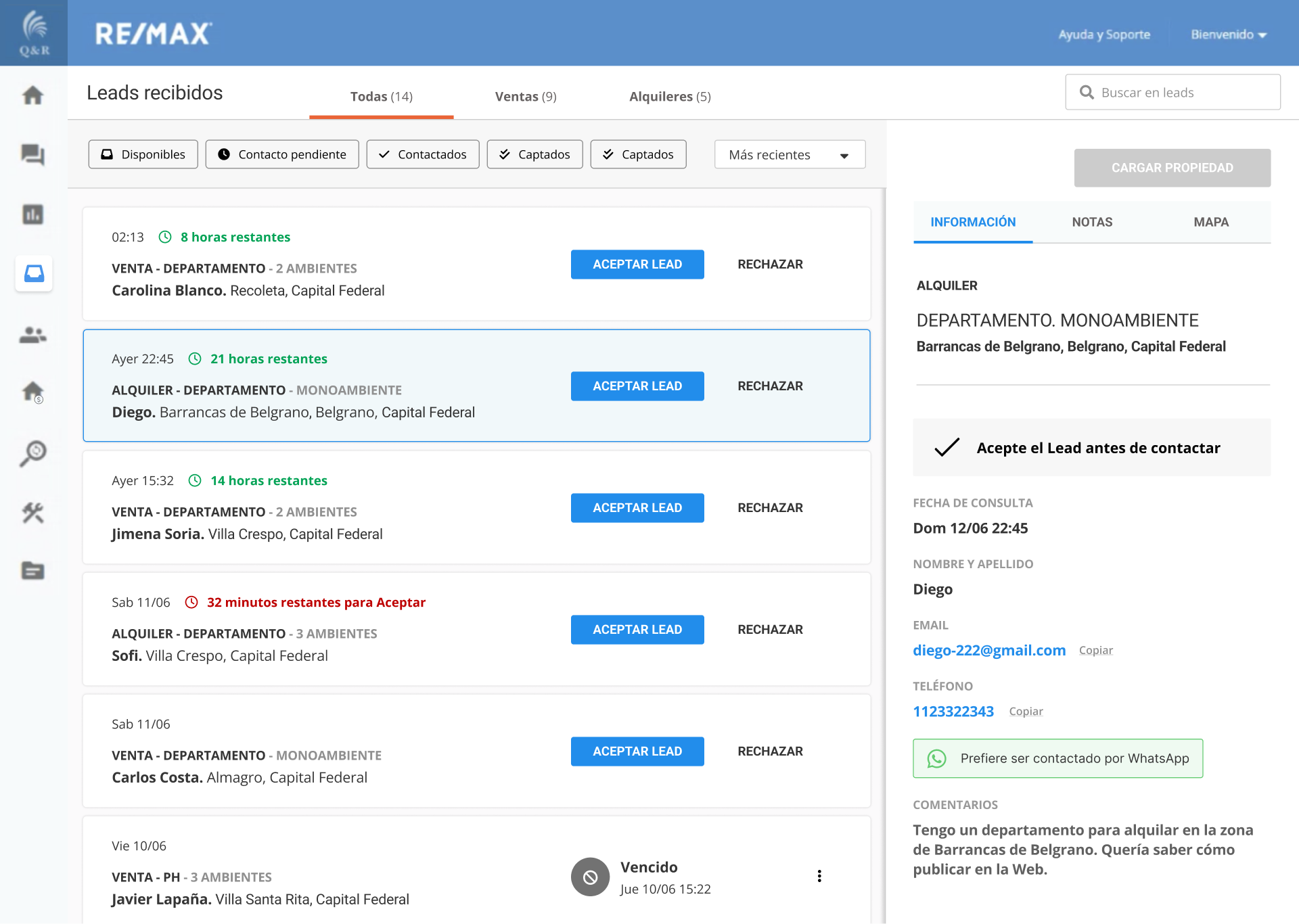
Lead list with filters and prioritization. Leads have a visible time counter.
Assignment system for offices and agents.
Information to support assignment decisions: distance to the lead, number of previous assignments and rejections, and eventually a score. (Future automation)
Clear process states (received, assigned, contacted, listed, rejected)
Activity history for full traceability
This transformed a scattered manual coordination process into a centralized, fully traceable flow, prepared for future automation.
Validation
I conducted usability testing on the prototype with agents and RE/MAX office managers, covering different scenarios.
Usability results
All users operated the system without significant usability issues.
The points that raised questions were quickly and intuitively resolved.
The process for rejecting or discarding a received lead was understood without friction.
The time counter was correctly interpreted as a signal of urgency and reassignment.
Identified opportunities for improvement
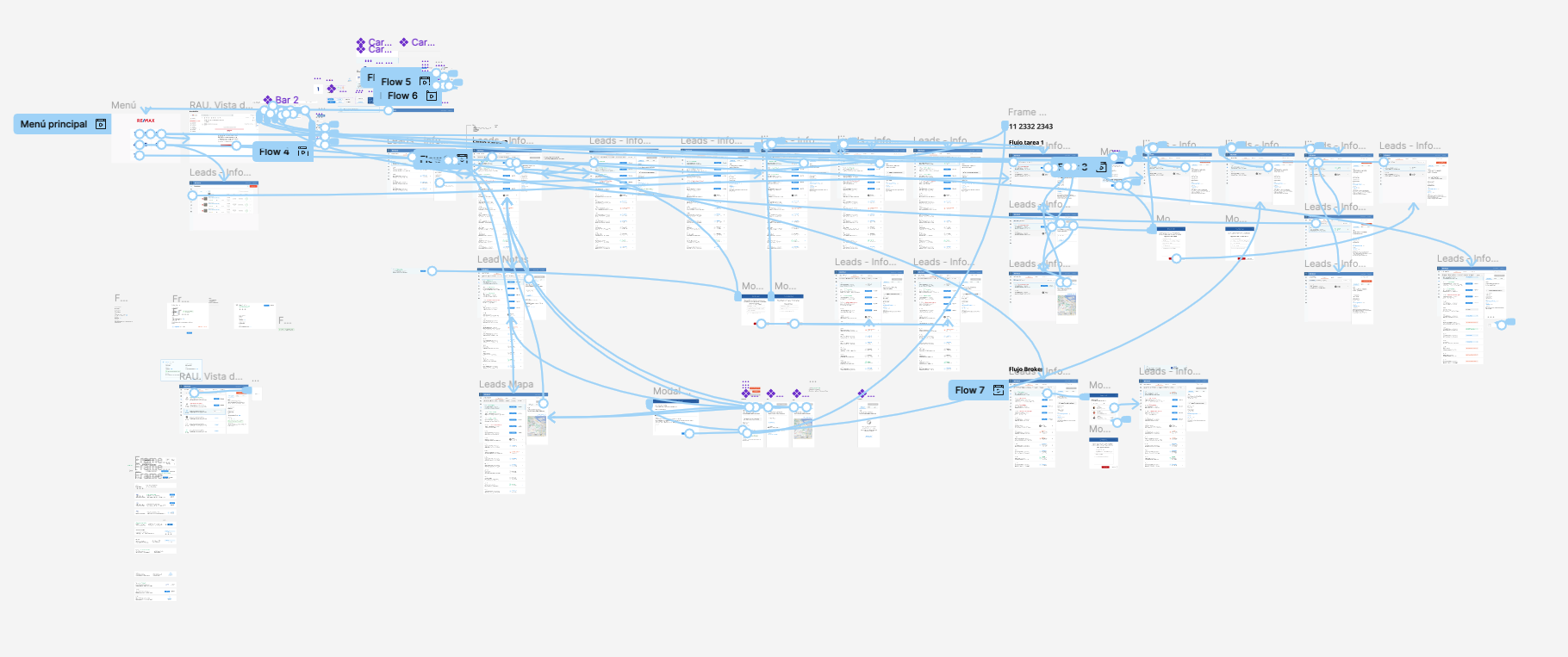
Client data was hidden until formal lead acceptance. Agents suggested calling before accepting.
Copy and label adjustments to create clarity around each action.
New states were added (such as "in follow-up") that agents explicitly requested.
Results
The project delivered a designed and validated system:
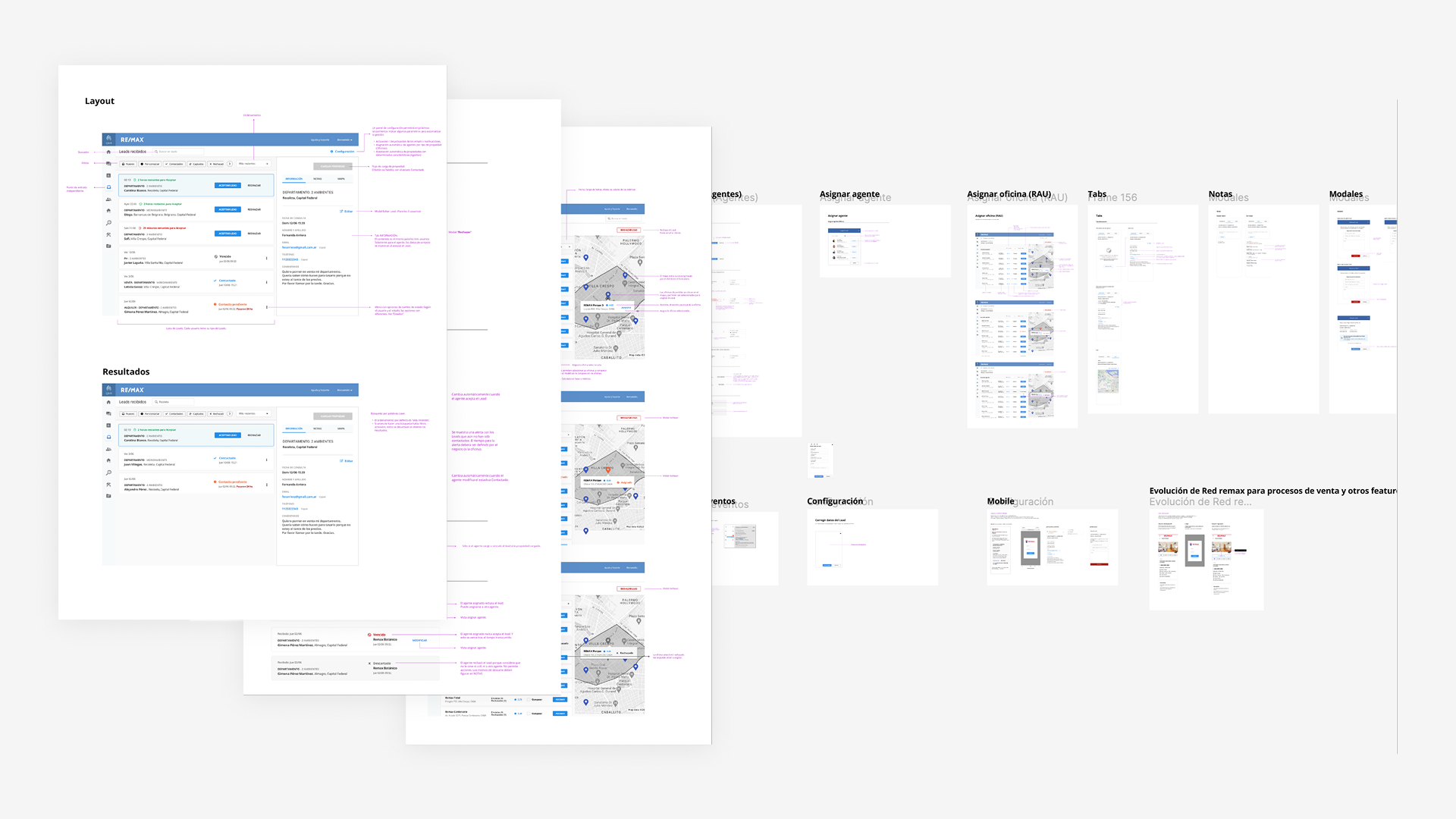
The system organizes leads through clear process states (received, assigned, contacted, listed, rejected).
It allows assignment to offices and agents.
It prioritizes urgent leads.
It provides full traceability through activity history.